
 Other
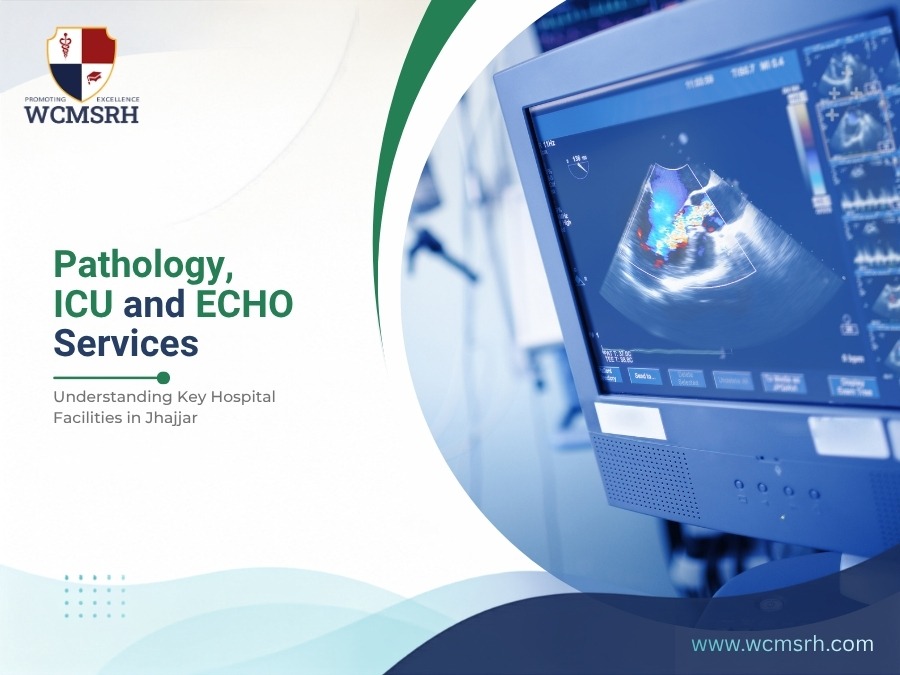
Pathology, ICU and ECHO Services: Key Hospital Facilities in Jhajjar
Choosing a hospital in Jhajjar is more than simply finding a hospital near you. Patients require quality diagnostics, timely medical care, and critical care support when needed. Pathology laboratories, Intensive Care Units (ICUs) and echocardiography (ECHO) services are three important facilities that aid doctors to diagnose conditions, monitor patients and make informed treatment decisions.
Residents seeking an ECHO test at the Jhajjar facility or comprehensive hospital services will benefit from understanding how these departments operate and make healthcare choices accordingly.
World College of Medical Sciences & Research and Hospital (WCMSRH) is situated on Jhajjar-Sampla Road and provides laboratory services, ICU facilities and ECHO tests for the patients in the area.
Why Modern Hospital Facilities Matter
Accurate diagnosis, proper treatment and ongoing monitoring are the essentials of modern health care. In a hospital, various departments work together to help doctors understand a patient\\\\s medical condition and decide what to do next.
Three facilities required are
- Pathology Laboratory: Examines blood, urine and other clinical specimens to help diagnose diseases and monitor health conditions.
- Intensive Care Unit (ICU): Care for critically ill patients requiring close medical supervision and specialized care.
- ECHO Services: Ultrasound technology to check heart structure, pumping function and blood flow.
Having these facilities within a hospital can improve coordination between diagnostic teams, treating doctors and critical care specialists.
Understanding Pathology Services in Jhajjar
Pathology services play a key role in preventive health care, disease detection and treatment monitoring. Doctors often order laboratory tests to investigate symptoms, determine how an organ is functioning, or to check how well medical treatment is working.
When looking for a pathology lab Jhajjar Hospital, patients should look for the types of investigations available, quality procedures in the lab and availability of reports.
Common Pathology Tests and Purposes
Various diagnostic tests offer information about particular health aspects.
- Complete Blood Count (CBC) : Checks the levels of blood cells and helps to investigate anemia, infections and certain blood disorders.
- Blood Glucose and HbA1c: Aid in the diagnosis and monitoring of diabetes.
- Liver Function Tests: Look for markers of liver function and liver damage.
- Kidney Function Tests: Check levels of creatinine, among other markers, to assess kidney health.
- Lipid Profile: Checks cholesterol and triglycerides; aids in assessing cardiovascular risk.
- Thyroid Function Tests: A test for hormones that relate to the activity of the thyroid.
- Urine Test: It is used to check for urinary tract infections, kidney problems and other abnormalities.
The official clinical biochemistry information of the WCMSRH mentions investigations like glucose, HbA1c, liver and kidney function tests, lipid profiles, electrolytes, thyroid hormones and cardiac markers.
Laboratory investigations are useful beyond the initial diagnosis. They also help doctors decide if the patient is getting better or needs more treatment.
Regular blood glucose testing, for example, can help to manage diabetes, while electrolyte testing can help doctors monitor patients with kidney problems or serious illness.
But laboratory values should always be interpreted according to symptoms, medical history and clinical examination. Does an abnormal result mean you definitely have a particular disease?
Importance of ICU Critical Care
An intensive care unit is a special part of a hospital for patients who need close observation, advanced monitoring or support for important body functions.
Serious medical conditions that cannot be safely treated in a regular hospital ward may be present in patients admitted to an ICU.
So, if you are looking for an ICU hospital near Jhajjar, you should know that ICU care is more than simply hospital beds. It requires trained health workers, surveillance systems, emergency medicines and access to appropriate diagnosis and treatment services.
Conditions That May Require ICU
Admission to ICU is on condition of the patient and clinical assessment. Typical situations include:
- Severe respiratory problems: Patients with respiratory failure or need help breathing.
- Major infections: Serious infections such as sepsis that affect blood pressure or organ function.
- Cardiac emergencies: Some heart conditions requiring constant monitoring or intensive care.
- Serious injuries: Patients with some major trauma or complication affecting vital functions.
- Postoperative complications: Patients needing intensive observation after major surgery.
- Organ dysfunction: Severe problems with the kidneys, heart, lungs or other organs.
Not all patients with these conditions need ICU admission. The level of care is decided by the doctors on the basis of how serious the illness is and what treatment is needed.
Essential Features of Intensive Care
A well-equipped ICU will generally have several important clinical capabilities:
- Heart rate, blood pressure and oxygen levels are monitored continuously.
- Ability to access oxygen therapy and respiratory support.
- Trained doctors, nurses and critical care staff.
- Emergency medicines and resuscitation equipment as appropriate.
- Infection Prevention and Control Protocols.
- Coordination with laboratory, imaging and specialty departments.
The WCMSRH states it has 24-hour health care facilities including ICU and laboratory services. Direct confirmation with the hospital regarding actual availability of ICU beds and the level of support appropriate to the individual patient is required.
Understanding ECHO Test for Heart
An echocardiogram, or ECHO test as it\\\\s commonly called, is a non-invasive diagnostic test that uses ultrasound waves to generate moving pictures of the heart.
An ECHO test looks at the structures of the heart and how well they are working, while an electrocardiogram (ECG) records the electrical activity of the heart.
An ECHO can help doctors see:
- Size and shape of heart cavity.
- Heart muscle motion and power of pumping.
- Operation of the heart valves.
- Blood flowing in the heart.
- Structural abnormalities and the presence of fluid around the heart can impair heart function.
The test does not involve ionizing radiation. It\\\\s often recommended when doctors suspect heart valve disease, heart failure or certain structural heart conditions.
When Doctors Recommend ECHO Testing
Doctors may recommend echocardiography when patients have symptoms or findings that require further cardiac evaluation.
Common symptoms include unexplained breathlessness, swollen legs, heart murmur, suspected heart valve issues or follow up of certain heart conditions.
In a routine transthoracic ECHO, ultrasound gel is put on the chest and a hand held device is moved over different areas to get images.
After this type of examination most patients can return to normal activities. Preparation for ECHO procedures may vary for specialized ECHO procedures.
Patients who wish to undergo ECHO test at Jhajjar facility can contact WCMSRH for appointment availability, preparation guidelines and current charges. The institution lists ECHO testing as one of its diagnostic services.
How Hospital Departments Work Together
Pathology, ICU and ECHO services have different functions but can complement each other in patient care.
Imagine a patient who presents with severe breathlessness. Doctors may recommend blood investigations to see any possible causes , ECHO to see how the heart is functioning and ongoing surveillance if the patient\\\\s condition worsens.
In those cases:
- Pathology findings provide information about blood parameters and the function of organs.
- Doctors use ECHO results to check for possible problems with the structure or function of the heart.
- ICU services provide close monitoring and treatment support as clinically indicated.
- The treating specialists also synthesize these findings to develop the appropriate care plan.”
Coordination of this type is especially important when patients are faced with multiple medical issues or when their clinical status is rapidly changing.
Choosing Suitable Healthcare Facilities Locally
Choosing the best hospital in Jhajjar should not be based solely on promotional claims, but on individual healthcare needs.
Here are a few things patients and families may want to think about before choosing a facility:
- Clinical expertise: Having the right qualifications for the condition in question.
- Diagnostic support: Availability of appropriate laboratory tests and imaging investigations.
- Emergency preparedness: Availability of emergency assessment and critical care services.
- Patient safety: Monitoring procedures and clinical care protocols, infection control.
- Accessibility: Easy to reach and affordable travel arrangements.
- Cost Transparency: Transparent information on investigations, admission fees and applicable health schemes.
You might be better off going to the nearest place that has the right equipment to stabilize you if you have a medical emergency, rather than going further to your preferred hospital.
Accessible Hospital Services Near NH 334B
Geographical accessibility is an important consideration, especially for patients traveling from Jhajjar and surrounding communities.
WCMSRH Address : 4 km stone, Jhajjar-Sampla Road, NH 334(B), Jhajjar, Haryana, PIN 124103
If you are looking for a hospital near NH 334B Jhajjar, this hospital is one of the local options for hospital consultation and investigations.c
The institution describes its multidisciplinary healthcare facilities like laboratory investigations , ICU support , and ECHO services . Patients are advised to check exact service times, current availability and referral requirements prior to visiting.
Making Smart Choices About Hospital Care
Pathology tests, ICU services and echocardiography are important components of hospital based health care. Together they facilitate diagnosis, medical monitoring and management of patients with varying degrees of severity of illness.
For families seeking a multispecialty hospital in Jhajjar, being aware of these facilities helps them ask the right questions and select care that suits their medical needs.
World College of Medical Sciences & Research and Hospital (WCMSRH) offers a variety of clinical and diagnostic services in Jhajjar. For more information on pathology investigations, critical care information or ECHO testing, patients willing to undergo the same can visit WCMSRH’s.
Also Read About - MRI vs CT Scan: Which One You Need? Diagnostic Guide for Trauma, Brain & Cancer Patients in Jhajjar
Frequently Asked Questions (FAQ’s)
1. Which pathology tests are commonly available in Jhajjar hospitals?
Hospital laboratories commonly conduct complete blood counts, blood sugar tests, liver function tests, kidney function tests, lipid profiles and thyroid investigations. Available tests differ between facilities. WCMSRH lists several clinical biochemistry investigations.
2. When does a patient need ICU admission?
ICU admission may be required for severe breathing difficulties, serious infections, certain cardiac emergencies, major injuries or organ dysfunction. Doctors assess the patient\\\\s condition before deciding whether intensive care is necessary.
3. What is the purpose of an ECHO test?
An ECHO test uses ultrasound waves to examine the heart\\\\s chambers, valves, movement and pumping function. Doctors use it to investigate suspected structural or functional heart conditions and monitor certain existing heart diseases.
4. Is an ECHO test painful or risky?
A standard transthoracic ECHO is generally painless and does not use ionizing radiation. Patients may experience slight pressure from the ultrasound probe. Other specialized ECHO procedures have different preparation requirements and potential risks.
5. Where is WCMSRH located in Jhajjar?
The World College of Medical Sciences & Research and Hospital is located at 4 km stone, Jhajjar-Sampla Road, NH 334(B), Jhajjar, Haryana – 124103. Patients can contact the hospital directly to confirm available services and appointment arrangements.