 Joint Replacement
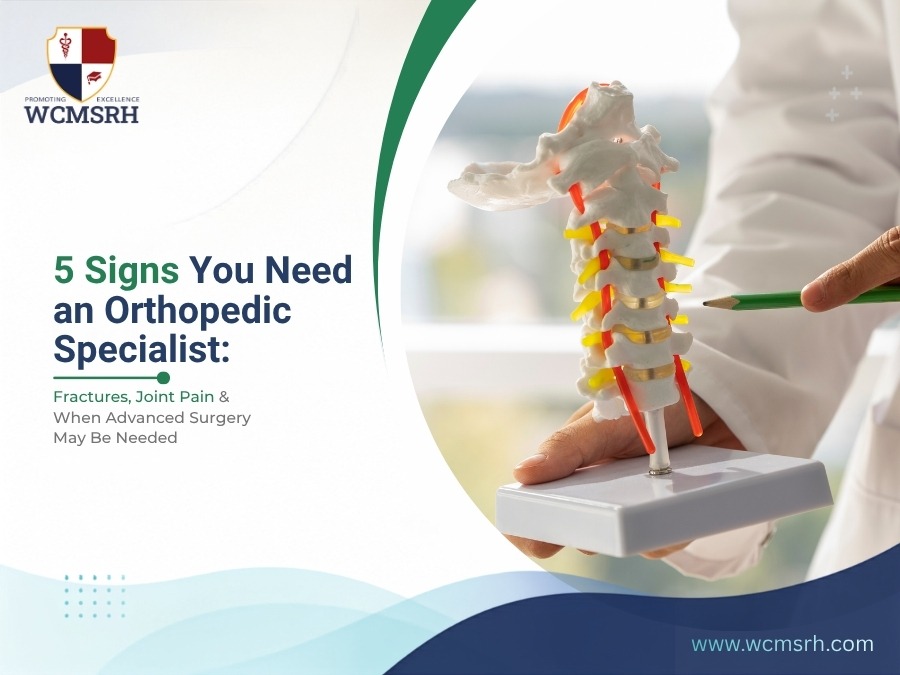
5 Signs You Need an Orthopedic Specialist: Fractures, Joint Pain & Advanced Surgery
Who Is an Orthopedic Specialist?
An orthopedic specialist treats bones, joints, muscles, and ligaments. They diagnose injuries and chronic conditions. They also perform surgery when needed.
Many people wait too long before seeing one. This delay can turn a simple issue into a serious one. Knowing the warning signs helps you act early.
Why Does Early Orthopedic Care Matter?
Bones and joints do not heal well when we ignore problems with them. If we have injuries, they can get worse over time because of the way we move every day. When we find out what is wrong early, it often means we can have treatment that is less invasive.
If we wait too long to do something about it, it can lead to chronic pain in our bones and joints. It can also make it more likely that we will need to have surgery on our bones and joints. That is why it is so important to recognize the symptoms of problems with our bones and consult with orthopedic hospital Jhajjar.
Sign 1: Persistent Joint Pain That Doesn\t Go Away
Sometimes your joints will hurt after you have been active. This is okay. If your joints hurt for more than a few weeks, that is not okay.
When your joints hurt all the time, it can mean you have swelling in your cartilage. You have arthritis that is just starting. It can also mean you have a problem with a ligament or tendon.
You should see a bone specialist Jhajjar. They can figure out what is wrong with your joints by looking at you and taking pictures with a machine.
Sign 2: A Suspected Fracture or Bone Injury
A break is not always easy to see. Some breaks lead to a lot of pain and swelling. Some only cause discomfort, especially when it\s a tiny crack in the bone.
Signs to watch for include something that looks wrong or out of place, not being able to put weight on the area, and sharp pain in one place. Also, if there is bruising and swelling that gets worse over time, that is a warning. Visit joint replacement hospital Jhajjar for bone replacement surgery from top doctors with care.
Sign 3: Limited Range of Motion
When you have trouble bending or straightening a joint, that is a warning sign. This can happen with your shoulder, knee, hip, or elbow. You might not be able to move these joints like you normally do.
Reduced mobility is often a sign that something\s wrong with the joint itself. This could be because the cartilage is torn or the ligaments are. The joint is just worn out. It could also mean you have a shoulder or the start of arthritis.
Sign 4: Recurring Injuries or Instability
Does a joint feel like it\s \"giving way\"? Does the same injury keep happening? This pattern usually indicates instability.
Instability commonly affects knees, ankles, and shoulders. It often results from previous ligament damage that never fully healed. Repeated injuries increase the risk of long-term joint damage.
Sign 5: Pain That Affects Daily Activities
This is one of the clearest signs it\s time to see a specialist. If pain interferes with walking, sleeping, or basic tasks, it needs medical attention.
Everyday pain isn\t something to accept as normal. It usually signals an underlying issue that requires diagnosis and a treatment plan.
What are the common advanced orthopedic surgeries that people get?
There are a few types of advanced orthopedic surgeries.
- Joint Replacement is one type of orthopedic surgery. It is used for people who have arthritis in the hip or knee.
- Arthroscopic Surgery is another type of orthopedic surgery. It is an invasive option that doctors use to repair ligaments and cartilage.
- Fracture Fixation is also a type of orthopedic surgery. Doctors use plates, screws, or rods to stabilize breaks during this surgery.
- Spinal Surgery is a type of orthopedic surgery that addresses severe disc or nerve compression issues.
Advanced orthopedic surgeries, like these, often mean that people have recovery times. Many advanced orthopedic surgeries are now done through incisions. This is because of techniques that doctors use for advanced orthopedic surgeries.
How Do You Know If It\s Time to See a Specialist?
If you notice any of the five signs above, it\s time for an evaluation. Early consultation often leads to better outcomes and simpler treatment options.
An orthopedic specialist can accurately diagnose the problem. They can also guide you through both non-surgical and surgical options based on your specific condition.
Final Thoughts: Don\t Ignore the Warning Signs
Your body is telling you something when you have pain, fractures, and mobility issues. These things do not usually go away if you ignore them.
Seeing a specialist as soon as you can is a good idea because it can stop small problems with your joints and bones from becoming big ones. If you are having pain, fractures, or mobility issues, you should go see an orthopedic specialist so they can figure out what is wrong and help you get the right treatment for joint pain, fractures, and mobility issues.
For expert orthopedic care, visit the multispecialty hospital in Jhajjar, World College of Medical Sciences & Research and Hospital (WCMSRH).